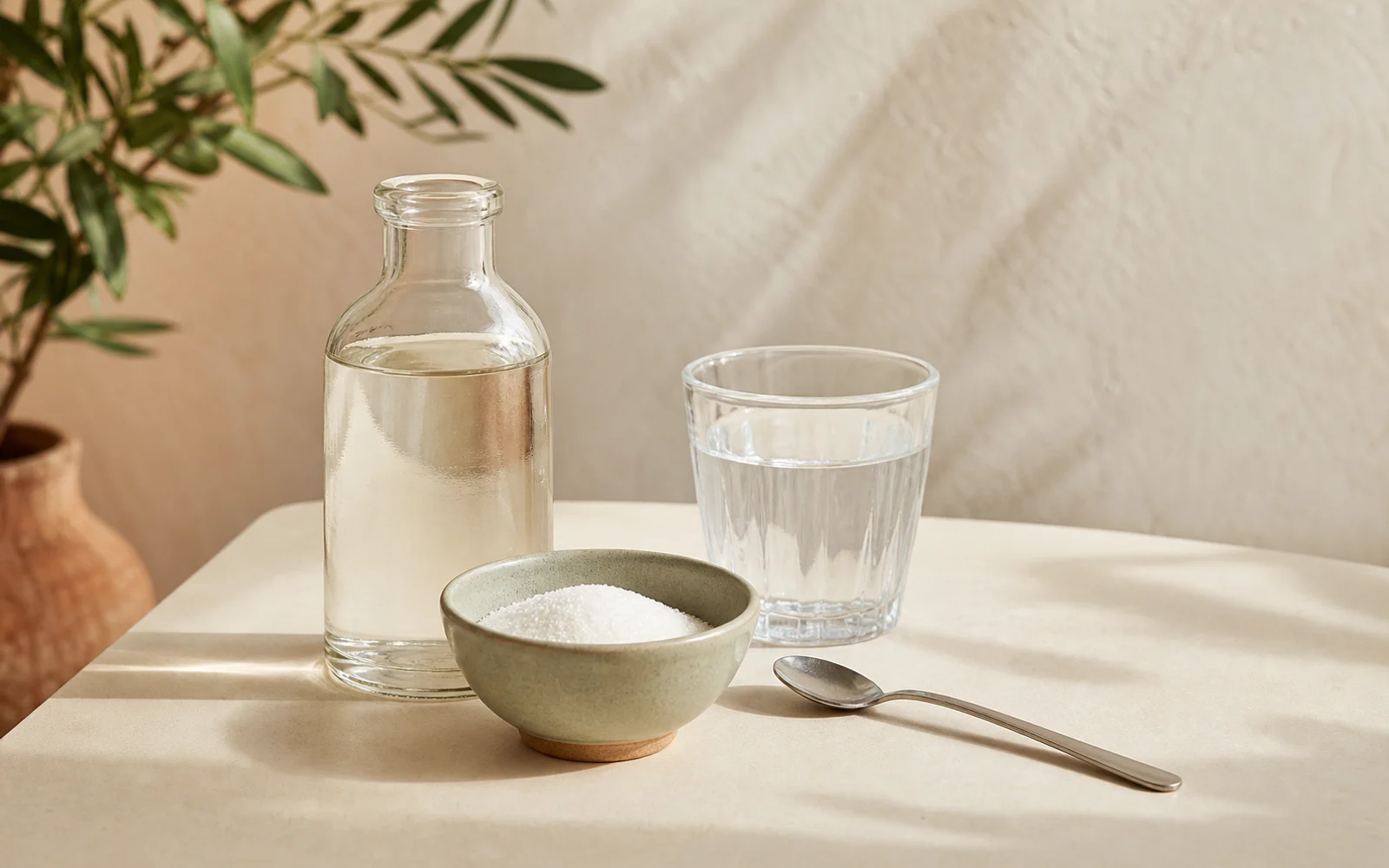
A recipe calls for 15 ml of simple syrup, but the bottle in your fridge is rich syrup. Swapping the same volume changes both the sugar and the water in the drink. A kitchen scale lets you control those separately.
I compared Jeffrey Morgenthaler’s weighed recipe with Difford’s Guide’s volume-based method. Both describe sugar-to-water ratios, but their measuring conventions differ. Check that convention before borrowing a conversion.
Label the batch by weight
For a small equal-weight simple syrup, dissolve 50 g (1.76 oz by weight) of granulated sugar in 50 g of warm water. Cool, transfer to a clean bottle, refrigerate, and label it with the ratio by weight and preparation date.
For rich syrup, use 100 g (3.53 oz by weight) of sugar and 50 g of water. Warm gently and stir just until dissolved. Prolonged uncovered boiling removes water and raises the concentration, making the conversions below less reliable.
With these weighed recipes, 20 g of simple syrup contains 10 g of sugar. So does 15 g of rich syrup, but the rich syrup carries 5 g less water. That difference affects dilution as well as the amount you pour.
Preserve sugar and water separately
This table applies to the two sugar-and-water batches above, with no significant water loss during preparation. Every quantity is a mass in grams, including the extra water.
| Simple syrup in recipe | Rich syrup instead | Extra water |
|---|---|---|
| 10 g | 7.5 g | 2.5 g |
| 20 g | 15 g | 5 g |
| 30 g | 22.5 g | 7.5 g |
| 40 g | 30 g | 10 g |
Equal-weight simple syrup is half sugar by mass. Rich syrup made with twice as much sugar as water is two-thirds sugar by mass. Use three-quarters of the original syrup mass to preserve sugar; adding the remaining quarter as water also restores the original water contribution. In reverse, 30 g of rich syrup plus 10 g of water makes 40 g of equal-weight simple syrup.
Omit the extra water if less dilution is what you want, but expect a different result. Keep the other ingredients and ice handling unchanged when comparing the swap.
A milliliter recipe needs a different step
Fifteen milliliters of syrup does not weigh 15 g. Syrup concentration changes density, and temperature also affects volume. Do not read the table’s 20 g to 15 g substitution as 20 ml to 15 ml.
If the recipe specifies simple syrup made with equal weights of sugar and water, weigh its required volume first, then use the table. If you only have rich syrup, mix 30 g of it with 10 g of water to make equal-weight simple syrup, then measure the milliliters your recipe calls for. This avoids guessing density.
For a quick drink, about 10 ml (2 tsp) of rich syrup can be a rough starting point in place of 15 ml (1 US tablespoon) of simple syrup. Mix and adjust with small additions. That shortcut does not precisely preserve either sugar or water. Use the scale when comparing recipes or calculating sugar.
Flavored and sugar-free bottles need their own judgment
The table applies only to plain granulated sugar and water mixed as described. Flavored syrups may contain other sugars, juice, or thickeners; reduced-sugar and sugar-free products may use other sweeteners. Thickness alone cannot tell you how much to substitute.
For iced coffee that needs sweetness, start with a little neutral syrup. Choose a flavored syrup when you actually want that flavor. If the drink becomes too sweet before the vanilla aroma is strong enough, adding more of the same syrup makes the balance harder to fix. Reduce it or add aroma separately with an ingredient already in the kitchen.
For occasional use, I would buy a large flavored bottle only when several upcoming drinks will use it. Frequent repeat use can justify paying for consistency and convenience.
Make small homemade batches, use clean containers, and refrigerate them. Rich syrup is not a guarantee of room-temperature stability. Discard syrup without tasting if you notice mold, unusual cloudiness, bubbling, or an off odor.
FAQ
How much rich syrup replaces 20 g of simple syrup?
For the weighed recipes here, use 15 g rich syrup for the same sugar, plus 5 g water to restore dilution. This applies only to plain sugar and water without significant evaporation.
What if a recipe calls for 15 ml simple syrup and I only have rich?
Mix 30 g rich syrup with 10 g water, then measure 15 ml of the resulting equal-weight simple syrup. Grams and milliliters are not interchangeable.
Is 1:1 by cups the same as 1:1 by weight?
No. Equal volumes of granulated sugar and water weigh different amounts. Check how the recipe author measures them.
Does swapping to rich syrup reduce sugar?
The table preserves sugar mass. To reduce sugar, use less and rebalance the drink separately.
How long will homemade syrup keep?
Home hygiene, containers, and refrigerator temperatures differ. Make small batches, refrigerate, and discard syrup showing mold, unusual cloudiness, bubbling, or an off odor; no fixed shelf life is promised.
Sources
- Jeffrey Morgenthaler on weighed syrup
Defines weighed sugar-to-water ratios and gentle warming. The conversion table is our mass-balance calculation.
- King Arthur Baking simple syrup recipe
Lists one cup of water as 227 g and one cup of sugar as 198 g, illustrating why equal cups are not equal weights. Its storage claim is not adopted.
- Difford's Guide syrup comparison
Uses volume-based preparation and rounded bar measures. Supports only the rough tasting shortcut, not our weighed conversion table.